- Host star
- TRAPPIST-1
- Star type
- Ultra-cool M-type dwarf
- Planet radius
- 0.92 × Earth
- Planet mass
- 0.692 × Earth
- Orbital period
- c. 6.1 days
- Orbital distance
- 0.02925 AU
- Discovery
- 2017 · Transit
Values are rounded from published catalogue measurements. Sky coordinates identify the host system, not a resolved planetary surface.
Small, rocky and still mysterious
TRAPPIST-1 e is close to Earth in size and belongs to a compact system of seven known planets. Its measured size and mass support a rocky-world interpretation. That does not establish an Earth-like climate or a surface suitable for life.
Where is TRAPPIST-1 e?
The system lies in Aquarius, approximately 40 light-years away. Its ultra-cool dwarf star is much smaller and cooler than the Sun. The planet completes an orbit in roughly 6.1 days.
What does habitable zone mean?
TRAPPIST-1 e receives a level of stellar energy that makes liquid water possible under suitable conditions. Habitable zone is a model-based description of irradiation. It does not confirm water, a protective atmosphere or living things.
What do we know about its atmosphere?
An atmosphere has not been confirmed. Recent Webb studies are investigating this question, and contamination from the host star complicates interpretation. A gift should preserve that uncertainty rather than turn an interesting possibility into a discovery.
Why this reconstruction is restrained
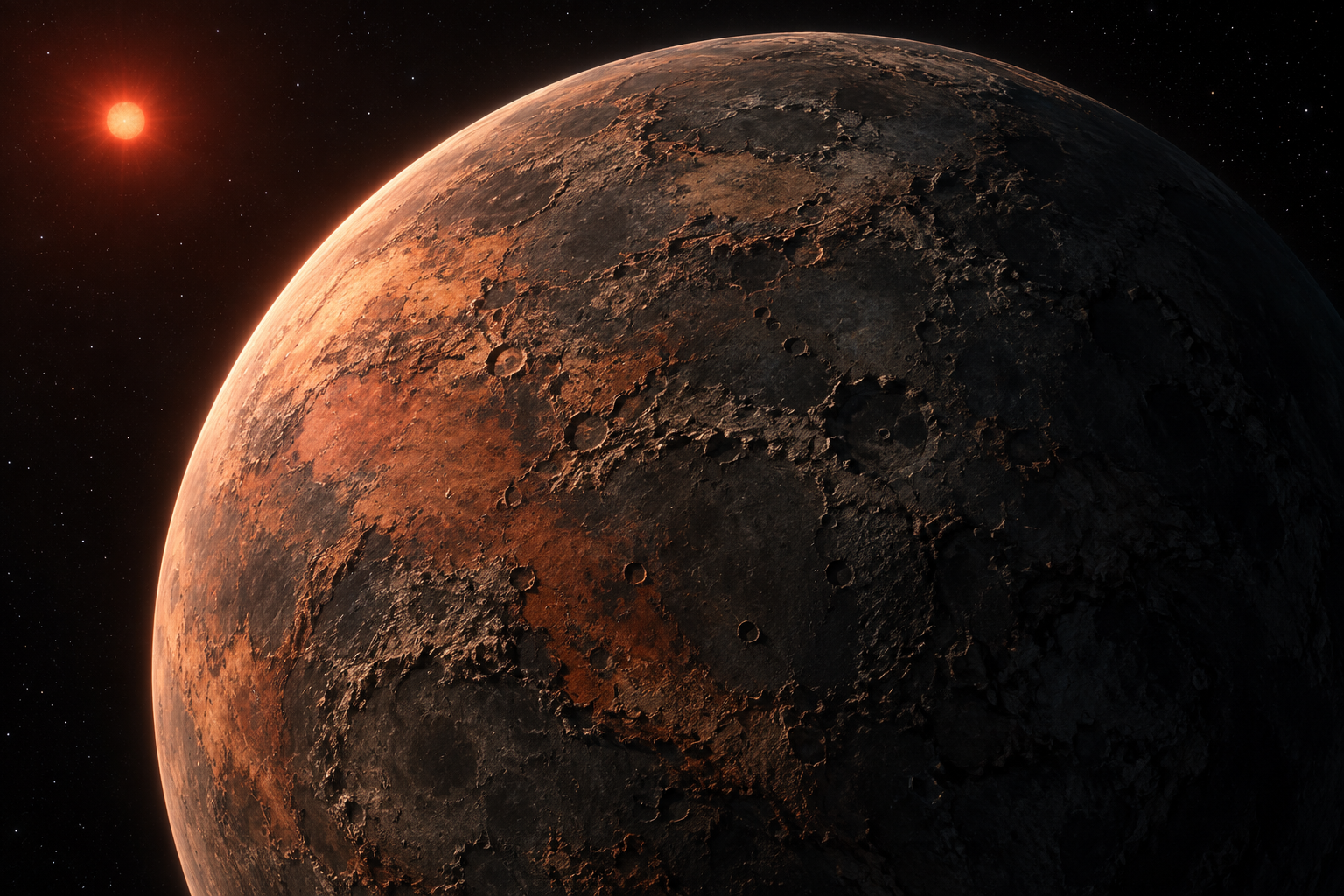
Dark rock, mineral tones and red-dwarf illumination convey a plausible terrestrial world. Specific terrain is imagined. We show no Earth-like continents, vegetation or blue oceans, and no confirmed atmospheric cloud system is implied.
How was it discovered?
The catalogue records a 2017 transit discovery. Repeated dimming events reveal the planet’s orbital rhythm and size. Its official designation stays on your artwork alongside your chosen ceremonial title, recipient and personal message.